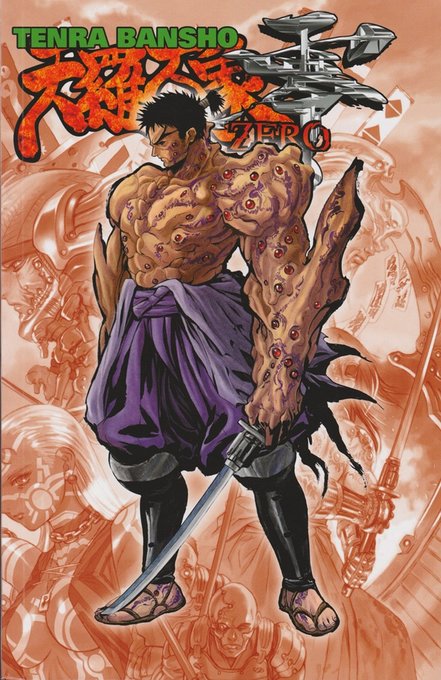
Showing posts with label Tenra Bansho Zero. Show all posts

Friday, August 14, 2026

Returning To Tenra Bansho Zero


Tenra Bansho Zero is one of the most influential games I have ever read. Its translated titled ("All Things Under Heaven and Earth") is literally what I named this blog after... and I have also never played a full game of it. 

We'll get back to why in a minute. 

But. 

In so many ways, this one game has defined my tastes. At one point, I gave my very nice copy to Pau Villarreal of The Warning. Well, I don't know if she got it. I sent it via the mail, and have to hope it got there. I figured she'd like the setting and it would get her imagination pumped. Hopefully I was right, but we'll never know. Ironically enough, the giving away of this book began an era of reading and investigation into the BR/OSR... which is coming to an end, as I picked up another copy. Not the fancy one. You can't find that one for a reasonable price, not anymore. Pau's got it, and I hope she's enjoying it, assuming she kept it.

The heart of TBZ is The Aiki-Kiai-Karma system. Each character has three Fates, which are these really open-ended statements of character, such as "Emotion: Hatred of Lord Kutuwara", or "My sword is the answer". Very open-ended, very simple stuff. Whenever you do something awesome with these Fates that everyone else likes, they can give you Aiki chits. You can spend Aiki, but it's not very powerful. However, if you wait until a good moment, you can convert Aiki into Kiai, which functionally does the same thing as Aiki, but you get a ton more of it. Like, 5x-6x more. Tons. If you spend Kiai, it gets marked as Karma. If you accumulate 108 Karma you became an Asura, a demon who is utterly incapable of change. And you then hand your character sheet to the GM, who then uses him to torment the other players.

It cannot be understated how much fun this one little system is. Players handing each other chits, which they then have to hoard in order to be of use, and then have to be careful about spending, is... there's nothing like it. There just isn't. People begin to lean into what the other players like, creating a feedback loop where everyone slowly gets more and more into their character. This enthusiasm transmutes into power in the game... and can lead to tragedy. There's something so layered, so genuine, so beautiful, about this loop. No other game comes close to it. Burning Wheel gets close, and Crescendo gets closer yet, but nothing beats the immediacy and depth  of Tenra Bansho Zero.

The setting book is also the single best setting book I've ever read. Ever. It is a blanket of loose ends, open spaces, unsaid things, and tragedies. There's tons of mundane details in here, all of which are just right. It is the only setting book I've ever read that justifies its existence, and we'll get back to why that is in a second, as well.

That's two grenades. Jeez.

The setting book is short, sweet, and knows exactly how much information to dole out. I could probably make scenarios out of this sucker for years.

Two and a half grenades!

Let's pull one now! Why did I give the game away? To a person who doesn't know me? Well, simply put: I couldn't figure out a way to pitch it to people! The hyper Asian setting is not something that actually appealed to my players at the time. The mechanics are great, but we had Burning Wheel, which scratches a very specific itch, and we now have Crescendo, which scratches that itch better. TBZ is not a campaign game. The mechanics aren't suited to it, period. The changes are so deliberately rapid that you shouldn't necessarily make sequels with the same characters. I didn't have anyone who needed just a quick pick-me-up.

So I gave it away. Like I said, I hoped Pau would get something out of the setting book.

After that, a funny thing happened: I started to slowly investigate the BR/NU/O-SR. I kinda figured I could find something to pick up the "adventure game" niche that TBZ so nicely filled, which Burning Wheel and Crescendo so definitely don't. And... well... I didn't, overall. I got ACKSII and 1e and Wight-Box, which is actually pretty good! Not to mention the Into the Odd family of games! I love them and will use them! But... they didn't scratch the itch. Not the very specific itch that was slowly developing: a game I could sorta pour myself into, and bring out for short bursts, with people either willing to take a chance or okay with just doing a one-shot. And, honestly, I wanted to give this incredible game another chance.

So. I picked it up again. I am just going to go and make a scenario, walk into my workplace, hand them the character sheets, and tell them they're playing. They'll play, because they're bored and we have nothing else to do at some very particular hours. And we'll play. And we'll have a blast. I know we will, because they trust my taste and are just bored enough. Just.

And then I’ll do it again.

And again.  

Maybe that’s the point. After years of circling this game—giving it away, hunting for something that could replace it, finally buying it back—I’m done waiting for the perfect table or the perfect pitch. Tenra Bansho Zero has already shaped how I think about play, about character, about the quiet tragedy of becoming something you can’t take back. Now I just want to see what happens when other people get their hands on those chits and those Fates.

I’ll throw it at my coworkers. 

I’ll throw it at my kids. And if it works even half as well as I remember it working on the page, I’ll finally stop treating this game like a secret I was never quite ready to share.

Onward!

Tuesday, June 9, 2020

Tenra Bansho Zero: Review

Kotodama Heavy Industries Roleplaying Games Tenra Bansho Zero RPG - Limited Edition Hardcover Two Book Set
Always two there are.
  
Let's get the elephant out the room: Burning Wheel is my favorite game, of all time. It's not a close fight. Similar to Clannad, it is so high up on my list I almost don't include it in favorites lists in my head, because those lists default to everything but those things. Every. Single. Time. I read a game I measure it against Burning Wheel. I can't help it. And you, the person who is reading this review, deserve to know that.

But why is that? Why is Burning Wheel preferred? I mean, the simple answer is that it's practically everything about it, but that majorly rests upon the artha system: players set their priorities, are rewarded, and then recalibrate what they want to do, and plug back into the aggressive mechanics. It's a game that helps you learn how you want to play with a holistic series of supports and challenges. It's freaking amazing. I find the loop addictive.

Tenra's loop is shorter, punchier, and easier to get into, with a similar level of emotional reward.

This is the best intro role-playing game I've ever played.

Period.


It also happens to be one of the best role-playing games I've ever played. If not the best.

Period.

Let me explain. I tried this game with two friends who have never played an RPG before. I know that's a shocking concept, that I have friends who I hadn't yet gotten to try RPGS with, but they do exist! At any rate, we decided we wanted to try this game out. Now, for all the years this game has gathered dust on my shelf I'm ashamed to say I'd never played it. So I read the advice, gave them pre-gens (pregen, actually, as the game advises that playing the same pregen with different Fates is enough. They're right, by the way), and had them change the Fates on the characters (we'll get there, hang tight), and we began to play.

Now, the way this game works is you have Fates. Fates are the things that your character gravitates towards, like light towards a black hole of doom. These are the things that your character cannot seem to escape. These are public table knowledge. When you role-play to your Fates in a way that others like they can give you what's called an Aiki chit. Aiki chits can be used to boost the power of your rolls and a bunch of other things. They're nice. Useful.

But the thing is that, if you hoard them, Aiki becomes Kiai. Kiai works very similarly to Aiki in boosting the power of your rolls and game manipulation, but there's a lot more of it. Like, generally four to five times as much. Possibly seven times. So if you hold out you can get a ton of Kiai and become an unstoppable machine of death! But there's a catch. Unlike Aiki, Kiai spent must be logged by the player. Kiai spent eventually becomes Karma, which essentially measures how close you are to losing your freaking mind. Hit 108 Karma and your character becomes an Asura, a demon, who is then requisitioned by the GM. You've just lost your character because he wouldn't let go.

So Ben and Logan began to play with this framework in mind. They'd never played an RPG before, I promise! I swear it! And this amazing thing happened. Using this system, the Zero system as it's called, they learned how to role-play better in five minutes than I've seen any single other game I've ever played, Burning Wheel included. Within ten minutes they had thrown in more subtlety and nuance than I'd seen from people who had literal years of experience on them. These novice players discovered a style, a genre, that they wanted to emulate, and the Aiki chits coming from the rest of the table reinforced what the "audience" liked about that direction. Realizing what part of their ideas were clicking with the other players, they began to purposefully modulate their performances to the taste of the audience. We're talking crass dark comedy of the very best irony. Or heartfelt family tragedy, plaintive and painful.

In the same twenty minutes.

The game literally taught two complete novices how to role-play, with no advice beyond "just make believe and see what the system does". All the encouragement and tips that I find myself giving in other systems, Burning Wheel included, was completely unnecessary here. They just played. And they learned. The story soared, on its own

Tenra Bansho Zero is the best intro game I've ever played. Period.

That plays out in the advice the book gives, although not in how the twin volumes are laid out. The advice that I used? It's buried in the back, after a huge section on how to build characters, which the book advises to not do until you've really mastered the system. I'm really disappointed by this decision, as it muddies the waters and makes it difficult for people who are new to the hobby to figure out how to use the game. Which is a bit strange, considering how well laid out and explained the base rules are! And how good the advice content is, once you find it. That's a huge mark against the game and is part of why I hadn't touched in seven years: I found it intimidating, and was learning enough intimidating games that I didn't want to even look at another one.

But this game is not hard.

It is light as a bee.

And stings as hard, emotionally.

You'll notice I didn't talk about dice mechanics. I really don't think that's necessary, but here ya go: the game's core is the Zero system. If like what someone else is doing with their Fates hand them an Aiki chit. If you need to roll in the game gather a number of dice equal to your stat and roll, looking to generate successes. The higher your skill the better your chances of success are, as the skill modifies the success number on the dice itself. You generally need one success. Should you fail the game expects the GM to impose a twist that doesn't invalidate or make the character in question look like a buffoon. Combat is round based, but if you attack someone in melee expect to get counterattacked, as that is a normal part of the system. Wounds make you stronger. Which is awesome. It just feels fantastic. There are just enough mechanics to support players, but not so many as to get in the way of the Zero system, which is the real hero of the hour here.

There are very, very, very few games that I would just say outright "Go buy this, it is worth it." This is one of them. Yeah, I know, it's got a weird anime/manga theme that may put some people off, but once those Aiki chits start getting passed... just go get it. Try it. I highly doubt you'll be disappointed.

Me? It's my premiere short-campaign/one-shot game now. I won't make that mistake again, believe me!

Tuesday, April 14, 2020

It's Still on My Shelf: Tenra Bansho Zero


I backed this at about the same time as Torchbearer, about seven years  ago.

Seven years???

No.

I refuse to-

Just no.

I just backed this. A year ago. I promise. Yeah, that's it.

Point is, I still haven't played it. I've always wanted to; the whole game is just so freaking cool, with varying levels of accessibility that scream "I WAS MEANT TO BE PLAYED NOT LOOKED AT". I wish I could say that I have, but I really haven't. Yes, I'm going to blame the Army for this one again, but the truth is that I've been a bit intimidated by the game.

Why is that, you ask?

Well, let's break this down. Tenra Bansho Zero (TBZ) is a Japanese RPG, the first to be translated into English. It's designed to be a four to six hour single session campaign. All the character development that one could possibly have in a campaign gets pushed into that single session. It's hyper intense, hyper focused, just freaking hyper. Everyone has what are called Fates, which are hooks that the players can use to perform so the other players award them Aiki. Aiki is a resource you either use to get a few extra dice for your actions, or you can use it to generate Kiai. Kiai is extremely powerful, but spending it accrues Karma (yes, you have to track it yourself). Get 108 Karma? your character becomes an Asura, a demon enslaved to his desires, and taken over by the GM. You can get rid of Karma by getting rid of or lowering your Fates. You get rid of or lower your desires, you let go, so that way you do not become corrupted.

And then after that incredibly intense session you do a completely different story, in its own session. With different characters.

And you do it again.

And again.

And again.

Each of these stories are supposed to be completely self-contained, jumping from point to point in the really well-detailed setting that the game provides.

In fact, I would argue that the setting is the gold standard for how to make an RPG setting: make a place that needs saving, for whom there is no way out other than the players. Make the players essential. You want people to be heroes? Make everyone else not. Want the players to be a light? Make a variety of darkness they cannot help but feel on their skin. The TBZ setting is so well done that that its quality alone has made me keep the game, just to reference from time to time, to make sure that I'm designing my own settings correctly.

Yes, that was a paragraph-long aside.  The point is that you have to jump around a lot. And, given my own background for preferring long-running campaigns, I found that intimidating. How on earth could I come up with that many campaign ideas, that quickly? That's a lot of campaign work. But ultimately what's won me over on trying this out as a series of one shots is that there are plenty of pregenned characters, all of which are more defined by their Fates (which are player and GM generated) than by their skills, which means that player work is relatively low. And there's nothing stopping you from following the translator's advice and just keep spinning one-shots from the previous session's ending. I mean, all problems were formerly a solution, so that part makes sense.

There's a lot going for TBZ. I really can't wait to finally give it a shot as well. Well, y'know, one day. We'll get there.