Showing posts with label The Book of the Short Sun. Show all posts

Friday, November 25, 2022

The Book of the Short Sun: Second Go


Reading Book of the Short Sun for me is like being talked out of suicide. There’s always this jolt, and then this burning resentment: what if I wanted to die, Gene Wolfe??? What business is it of yours if I live? How dare you talk me out of the only action that makes sense? At the beginning of my RPG Crescendo I had written the following dedication to Gene Wolfe:

In eternal memory of Gene: 

I’m still a coward. 

This is the best I can do, for now. 

I know you’d understand.


A few friends of mine have quibbled with me over this dedication. They don’t see me as a coward! Not at all! No, they see the horrors I’ve survived and assume courage got me through them. They don’t see that a part of me still hasn’t made up its mind. It stands on the ledge, it still holds the knife at my thigh, the gun is in its mouth, and it cannot make up its mind. It’s too afraid to jump, to cut and bleed out, to blow its brains out… but the alternative scares it just as much. I’ve seen much in my life, why would I try and live through more? How could I be so crazy??? Why the hell make such a choice? So here I sit. Not making up my mind. I am the worst coward of them all. And it wasn’t until Short Sun that I knew it. I could practically hear Wolfe chuckling from beyond the grave, as step by wretched step he showed me my true colors. 

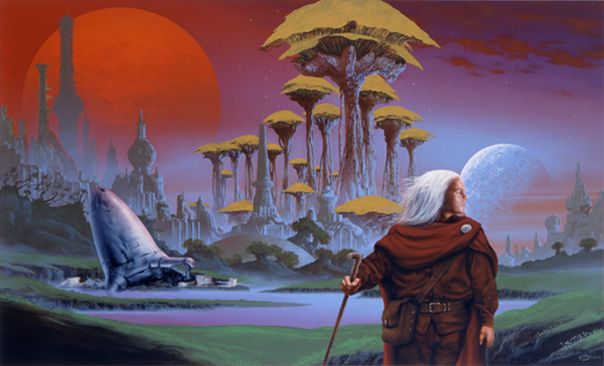
Book of the Short Sun takes place decades after Book of the Long Sun. Without Silk’s leadership the new colonists of Blue and Green, as well as those still aboard the colonizing worldship called the Whorl, have stagnated. Devolved into war and barbarism. The blood-drinking inhumi treat the new inhabitants like livestock. Horn, Silk’s closest student, resolves to find Silk and bring him back to save everyone from moral and physical death.

It is the saddest book I’ve ever read. It is also the only book that made me cry harder on a reread. I don’t mean pretty little tears; I howled as something in me finally died, gently and quietly. There’s a complexity to rereading Short Sun that I’ve not found in the rest of the Solar Cycle. I’m not saying that there isn’t complexity in the others, but for my money so far Short Sun’s layers have made the reread more tragic than anything I’ve ever read. Horn and Silk are both on the ledge, they both have a knife to the thigh, the gun’s ready to go… and so they’re kind. Almost as a matter of course: a dying man wants his last acts to be something he can live with in those last few moments, after all. And everyone mistakes it for courage. For normative kindness. Horn and Silk know the truth of course, you can’t convince someone whose soul you just accidentally saved that the only reason you were any good at all was because you knew exactly how they felt. 

You were only a step behind them is all, and not because you were later in your decision.

There are more than a few who do not see Book of the Short Sun as properly part of The Solar Cycle, but instead choose to see it as this retcon that has little to do with its supposedly finer entries, Book of the New Sun and Urth of the New Sun. After the second reading I not only declare that manifestly and obviously wrong, but I ask those who disagree a question: who are Tzadkiel and where does his ship come from? Not to mention Father Inire?

Short Sun actually answers those questions, whether you like it or not.

I will leave you with yet another biographical note. Once not so long ago that undecided part of me was about to make up its mind. Again. I could not argue; the decision was made. I was so worn out. I begged for mercy. I’d not come so far and fought so hard to lose here! But it was no use. I could feel my body go cold. It was over.

I was, in my mind’s eye, suddenly holding a young woman’s face in my hands, which tingled with her tears. I found myself saying over and over “Hold the course. Just hold the course”. Her streaming eyes widened and she whispered “It’s YOU”. I’ve prayed for this girl ever since. The part of me that hasn’t made up its mind now has something to do. And so it does it. I don’t know why that’s enough for now. But I’m not going to argue.

A few weeks later my long estranged Mei-Mei, the first woman I ever loved fully platonically, died. I was devastated; we’d had a nasty falling out and had never really been reconciled. I also happened to be on a med that had the side effect of making managing emotions practically impossible. So that made for a uniquely hellish cocktail. I went into a grocery store, praying for Mei-Mei.Choking back tears I could normally handle…  but with the drugs? No way in Hell.

Hello. I’m scared.

I stopped. Dead in my tracks. The female voice that reverberated in my skull was just shy of audible. And familiar.

I’m scared, she said. 

“Not on my account,” I whispered. 

There was a sigh of relief. And I was alone with the water, pumping shoulders, and the raggedy gasps of someone who knows he will have to see his friend at another time. A very long time.

The next day one of my best friends seemed on the verge of giving up on himself. I don’t know how true that was, given how addled I was by grief and the side effects of the drug. So I put my foot down. I stamped. I may have screamed at my friend. By the end of it he was only getting more and more angry and something inside of me began to wear out. But I couldn’t, wouldn’t, give up. The conversation ended and I was convinced I hadn’t just failed, but had made it worse.

The next morning I found myself hardly able to move. I could feel my soul had had enough. I was so weary as I sat in the bathroom I was genuinely afraid I was going to die. My body felt wearier and wearier, the type of tired I couldn’t possibly feel upon waking up more than a few minutes ago. I found myself lying on the cold tile. I couldn’t not close my eyes. I couldn’t hold the dark away with my eyelids , not anymore.

No, something said. It was firm, but gentle. No. You stuck it out with your friend. You don’t die today. You have so much more to do yet.

And I was back with that strange black-haired girl, holding her face as she wept. “Hold the course” I heard myself say. And I knew then the words weren’t just for her. Somehow I’d spoken those words to myself too. And that past hers could hear it too 

Life coursed back into my veins like an electric blanket someone had just turned on. I could move again, somehow. So I got up and moved about my day. I made it to the end of the day and collapsed into my bed, and passed out immediately. The little death is such a mercy, is it not?

If you think that has nothing to do with this masterpiece of a book you’ve either not read Short Sun (which, while sad, is forgivable) or you have and quite possibly thought Green is Luna, Urth's moon, a bunch of years in the future. Or that the Neighbors are just aliens.

Neither of which is true.

I changed the dedication to Gene in Crescendo. Here’s what it says now:

In memory of Gene: 

I couldn’t remember.

Try as I might, I couldn’t do it 

So I sat in the dark.

I’d not seen light in so long. 

But I heard you.

You reminded me I was not a creature of light. But I could be, once again.

I could return.

And so now I wander, stumbling through it all. I do not do so without hope.

I will see you someday, at the Gate, where Eve awaits all her children. Adam will be just beyond, beckoning.

I’ll be holding this.

Saturday, April 10, 2021

The Lie of Self-Identity

light spoilers for Book of the Short Sun to follow

ADDENDUM: As has been brought to my attention, my terms are not well defined. I'll attempt to define the most important one: Self-Identity. By Self-Identity I mean a constriction of yourself to what you think of yourself. I am not using Self-Identity as a noun, but as a verb that indicates a toxic toxic attempt of self-smothering so you may continue to retain your illusion about yourself, including suppression of experiences that would change how you see yourself and the world, trying to change your environment (or yourself) to match an image you have of yourself, lying to yourself that you didn't mean to do whatever mean thing you very clearly did on purpose, etc. Hopefully that clears things up.

I don't recognize the person that looks back at me in the mirror. I just don't. I haven't for decades. The person who gazes back at me isn't who I feel myself to be. The person people seem to know and talk about with my name attached to it I haven't recognized in even longer, and when I do recognize the person they're talking about it's the raging thing I work as hard as I can to restrain (which means I've failed yet again), or this deeply insightful person who is really just the byproduct of decades of heartbreak. There are memories people try to share with me that I find myself completely ignorant of. All I find when I look into my memories is a dark pit. How do you tell someone that you recognize them, but that may really be it? So I smile and play along. The memories I do retain most people don't seem to remember, to the point to where I wonder if I didn't just make them up. Maybe I did. Maybe my memories just aren't real. 

Maybe you're not real.

I've no way of knowing, the vast majority of the time.

Retreating doesn't seem to do me much good, so I just throw myself into whatever situation it is, hoping I'll figure out what's going on. I frequently don't. But I didn't back down. And that means something to me, whatever that's worth.

Gene Wolfe, an infantry vet of the Korean War, has always dealt with identity. What is it? How do you define it? Can you define your identity? Is it an individual's choice, who they are, or is it the community, your relationships, some weird combination thereof? Book of the Short Sun deals with these questions the most directly of the Solar Cycle, and I'd argue it is the point of Wolfe's science fantasy series. We follow along with Horn as he runs smack-dab into the fact that he's not who he thinks he is, over and over. Bad or good begin to blur as Horn's self-conceptions prove to not just be lies but damnable lies, causing more trouble than they're worth, but yet how are you supposed to move about in the world?

How are you supposed to act if you can't develop a proper conception of you? And never will? 

What if your ideas of you don't matter for being a person at all?

I'm not sure what exactly I'm driving at with this blog post. All I know is that the ending of On Blue's Waters, the first volume of The Book of the Short Sun, stopped me dead in my tracks. That first volume is watching someone's self-identity crumble. Horn does truly heinous things that are truly beyond his control but he did them and he experienced doing them and nobody can tell them they weren't his fault because fault doesn't matter and never did. 

He experienced it. 

And that was enough. 

Fuck the whole concept of fault, period.

The rest of the book shows Horn trying and trying to grow beyond his (supposed) misdeeds and failing, over and over. He wants to be the person that he thought he was and he knows he can't do it, but there's just no other thing for him to do, right? If you aren't who you think you are then why live? Why even bother? But he holds onto this mirage we call identity, fighting for it harder and harder. Horn doesn't ask what seems to be obvious to me now: why does what I think of myself matter, at all? But he doens't ask. He gets a lot of people killed over it.

And at the end of that volume Horn finds himself looking into a pool of water. And he doesn't recognize himself. What's staring at himself is a broken shell of a man who Horn does not want to accept.

He failed to retain the mirage.

I put the book down and sobbed for him. And me. There wasn't anything to be done. Self-identity is not real. And it never was. There is no way to sum up a person, especially if it's the individual in question. Because we all want to be something that we're not. And it does us no good, even if we think we achieved it. 

The rest of the Book of the Short Sun delves into this concept much harder and provides an answer, of sorts. I'm not really going to get into that now. But the beginning of self-knowledge is to be able to let go of the concept that you know who you are. And that you will ever fully learn who you are. You are larger than you know, infinitely so. So am I.

And no cheap thing like self-identity is going to even scratch the surface of the depths.

Every translator is a traitor, and that goes double for the lie of self-identity, which is when you try to translate yourself to yourself.

What a miserable concept.

Idolatry, in one of its purest forms.

Wednesday, January 20, 2021

The First Go Around on the Solar Cycle


Aesthetics is the height of morality. If you want to know who a person is ask them what their favorite bits of media are, and you'll get a very good idea of what it is they think moral. And for the most part this is fine. We read things that help us find meaning in a world that can be very difficult to navigate, sticking to them because they help us inform what to find joy, and thus meaning, in. It is pleasurable to rest in our ideas of how the world works.

But pleasure is not enough. We like it, but ultimately pleasure stifles us and helps create addiction. One must challenge oneself with things that are beyond taste. And that's what I think classics are for. Books that are inherently hard to read because they're not out to tell some plot about people going and doing the things, but are intrinsically honest to the point of discomfort. Meeting people will always shatter your expectations of reality. And that's ultimately what a classic is: it's a person, coded into written form. Some of these books get collected up into the canon of humanity that we've put together and get passed down, sometimes to referred to as Great Books.

I don't know if The Solar Cycle will ever be counted amongst that number for the rest of humanity, but it sure has been a classic to me. While it has said a lot of things that I agree with, and while I do find it enjoyable, every last book of the Solar Cycle has pushed me, forced me to re-examine my beliefs, to ask what it really means to be a human being, what being good and evil truly are, and even what the nature of reality is. And, similar to the other classics I've read, I've found that I developed a relationship with the books the way one does with a person. But, unlike most classics, The Solar Cycle has made me uncomfortable because it has told me that what I had already suspected wasn't even the half of it. That, instead of being insane, I was timid. 

That's not a word that usually gets thrown at me. And the Solar Cycle throws it at me often. I am timid for seeing what I've seen and not saying it louder. That the paradox that is reality needs to be pushed louder, harder. That to be confounded is the result of true perception. To see even a little bit of the world is to break your mind.

I'm not entirely sure what to make of this news. I kinda figured I was in everyone's face as it was, but that's not really what's being asked by the books, now is it? This book doesn't fight or scream or tell people they're wrong. No, the book just presents the paradox. And asks for you to either take it or leave it. And I suck, so very badly, at that. 

So much of the world makes very little sense. It's not that the world in abstract doesn't have some sort of sense to it, only that we cannot predict what we're going to run into. It's always a question of what we're going to do with what we understand, and what we'll do when it turns out we were wrong. And we are always, always, always wrong. The world is a far more compassionately ruthless place than could ever imagine. God is kind and cruel in equal measure.

And without embracing that paradox no one will ever be their own, truly paradoxical, selves.

Damn skippy I'm rereading it. I may never find anything like this, ever again.