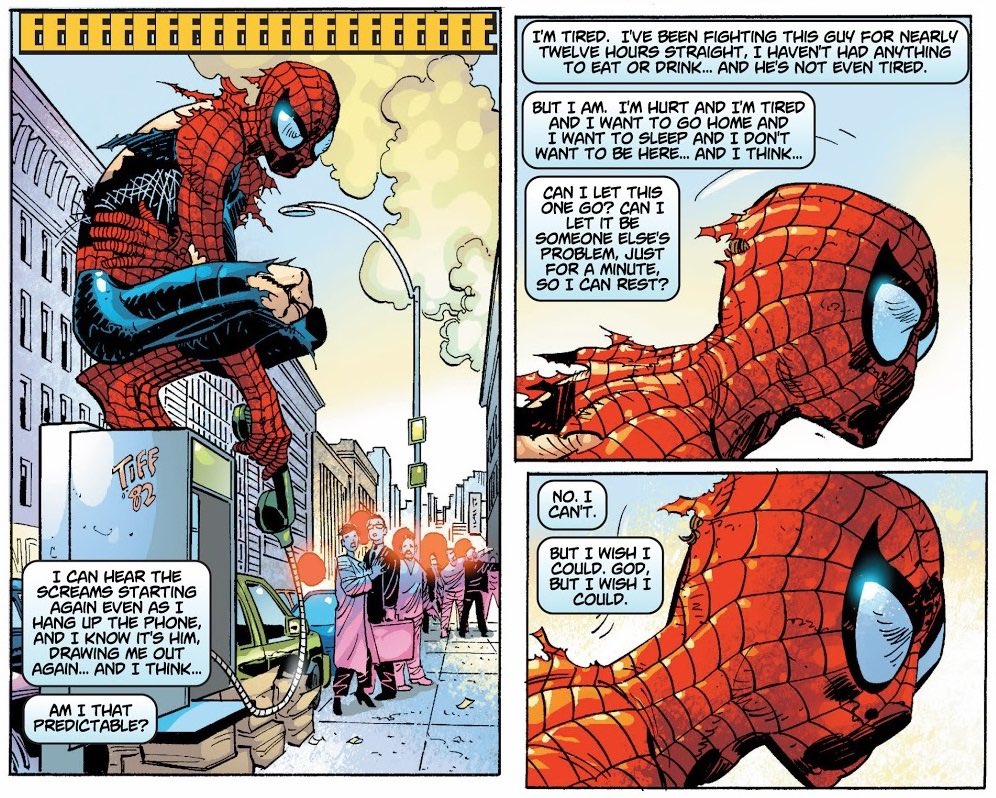
"We think that we know a man or a woman, when so much of what we know is actually that man's or that woman's situation, his or her place on the board of life. Move the pawn to the last row and see her rise in armor, sword in hand."— Gene Wolfe, Home Fires
"In so far as I am not loved, I am unintelligible to myself."- St. Dimitru Staniloae, The Experience of God
The central problem of most RPGs is the lack of any real-group dynamics, also known as the "get along gang": people who are together and it makes absolutely no sense as to why. They haven't killed each other, but they're not friends, despite having lived through tumultuous circumstances together. There's a gray zone where nothing is truly established in the group, and people just sorta... muddle along. No matter what happens, nothing changes between characters, not really.
For an extreme structural example: in one game a player ran an openly evil character who began committing escalating acts of coercion and sexual abuse against an NPC. His alignment was known, yet it still left the table unable to read the situation. I thought it would do enough, but it didn't, because there were still too many gray spots. Was this coherent (if reprehensible) roleplay? Boundary-testing? A cry for help from a player who was personally deteriorating? Because the characters had no real relationships or shared moral baseline, and the players had no deeper knowledge of one another’s characters or states, everyone stayed stuck in that gray zone—uncertain how, or whether, to respond.
Old-schoolers will think that I am solely referring to modern DnD tables there, but no. The same things can happen at old-school tables, and it looks about the same, between the characters and their players.
See, both games do the same thing:
"Hi, I'm Nathan, and I'm playing Xenith, a lawful good paladin".
You see the problem? These are aspects of someone, but they're not who the person is. If anything, these are the makings of a parasocial relationship. Xenith is a lawful good paladin, sure. But nobody would know what to do with that. You get a picture, but you don't get a person out of that. How far can you push Xenith's lawful tendencies? He's a paladin, but why? What drives him in being a paladin? What get him to stop? And how might Xenith change his small and personal aspects, the stuff that actually makes roleplaying fun? These are questions that players actually need the answers to, in order to roleplay. And, let's be clear, sometimes players do need to ask these questions. A game that's about playing a role shouldn't make you guess as to how to address them. That utter lack of clarity makes the central point of the game a matter of luck or tons of trial and error.
Which games are specifically supposed to not do!
And before some smartass points out that DnD's source material doesn't do this, it absolutely does, even with Conan, who was said to wander because he was struggling with depression and black moods that he tried to avoid. You know exactly who Conan is: a man driven by his darkness to find life, however he can get it, morality be damned.
And, again, before some smartass points out this is theatre kids shit, I remind you that 1e ADnD literally has a table for how the races are supposed to interact with each other, and penalizes you for ignoring it.
Yes, RAW 1e DnD enforces RPing. But it also falls into the same problem: the center of what makes a character a character is not actually addressed. It has better tools, sure, and you could use them better, but better doesn't mean good, it doesn't make roleplaying a game.

This problem was solved, almost entirely, the instant I went to Burning Wheel. See, Burning Wheel has what are called Beliefs, and they are public knowledge. Here's Xenith's Beliefs, if I were to put him into Burning Wheel:
1. Bahamut the Platinum Dragon spared me from a life of hardship; my sword is his.
2. Honor is the only thing that matters.
3. Elkvor took advantage of my mercy. I will not let that happen again.
The difference really couldn't be starker, could it? You know exactly what Xenith is about now. The Beliefs are public, and nobody has to guess about what Xenith is about. And because the other players don't have to guess, they will treat Xenith in a consistent way, and that consistency will create a sense of identity.
And with identity, there's relationship in return. And now you have a cycle going. A loop that will keep people coming back for more.
Not only that, but thanks to the artha system, you know I am rewarded for playing my Beliefs to cause drama, and for playing against my Beliefs, if I think it a good idea. There's even a "Go do something so awesome that it just isn't captured by your Beliefs" reward, and it leads to some truly elevated roleplay. Now other players can decide to write Beliefs that clash with mine, or that work with it, and they get rewarded with power regardless. The most basic social element, choosing to ally or be against, suddenly becomes an actual choice in the roleplaying game. Alliances and grudges now have gameplay weight, because identity is clear.
With Beliefs public and rewarded, the gray zone collapses. Xenith is no longer a collection of labels; he is a person the table can see, push, support, or oppose. Alliances and grudges gain weight because identity is no longer a guessing game. Move the pawn to the last row, and the character can finally rise in armor, sword in hand—because everyone at the table now knows who he is, including his player.

No comments:
Post a Comment