
When I was in my late teens and early twenties I hung out with a lot of Catholic priests, particularly Eastern Catholic ones. One of these priests in particular was kinda like an uncle to me. He was a cheerful man, full of life and the vigor of a person whose mind was always working. I admired him; my love of Dostoevsky and more grounded stories comes from the hours of conversation spent discussing our wildly differing tastes in narrative. To the best of my knowledge he is still at his parish, joyfully serving them. I miss him. I hope he's okay. But there was a habit this priest had that haunts me to this day.
When he came into his house he would say "Honey, I'm home!" to the empty house. There was a bit of an echo, every time. And every time my heart broke all over again.
Sometimes, when I close my eyes, when I cross the threshold of my house, I hear him. Still.
If you think he's the only Catholic priest who has this sense of sadness crossing the threshold of his house you're dead wrong.
Look folks, this is about to get really uncomfortable for any Catholic. We're going to look at the ugly reality of "universal" priestly celibacy. It is not a universal apostolic tradition. It did not rise organically within the Western Church, and its universality in the West was imposed forcibly, resulting in plenty of nephews and nieces and broken hearts. I've nothing against celibacy itself, but the corruption of Father Paul resides in this abusive and awful system. I do think some people are called to celibacy, but it is not an assignment anyone can give but God.
First off, this is not an apostolic practice. Most of the apostles were married. They were not commanded to put their wives away to preach, and they didn't. On the contrary, St. Peter's wife traveled with him and preached as well; St. Peter helped talk her through martyrdom! St. Paul's "I wish all were like me" is usually taken grossly out of context, particularly the Song of Songs, the height of all wisdom literature. The Eastern Churches repeatedly tried to warn against this practice, referencing their own apostolic practice of married clergy.
It gets uglier. Despite the warnings (and unanimous practice) of every single (and I do mean EVERY) Church the West continued in its idea that celibacy was necessary for all priests. It was clearly and obviously a hatred of marriage as it existed, with celibacy being considered the higher calling; marriage was a consolation prize, at best.
Now, to be fair, existing Germanic and pagan marriage practices were hardly virtuous; what a Western Christian's ideal of marriage was at the time looked very different than how the modern Catholic imagines it today. Everything revolved around the clan, making marriages extremely political. A lot of marriages in the Germanic tribe were thought of as how we'd think of as a political marriage. Young men and women were being essentially sold to secure the clan. And they'd better reproduce, because their good was the clan's. Right?
Right?
The Catholic Church railed against the whole thing. Marriage was a sacrament, and the clans had no business using people the way they were. Celibacy was likely seen as an escape from an oppressive and demeaning system. Marriage couldn't be a good thing, not as it was.
So to be married was to be embroiled in the clan, something the Catholic Church obviously didn't want. But needs are needs; priests were mostly free to be married until 1049, when Pope Leo IX issued a universal ban, with the Lateran Councils of 1123 and 1139 backing him up. The local clergy largely ignored the utter foolishness of such a measure. Until the 13th century priests had concubines and plenty of nieces and nephews, with parishioners generally in the know. Then the bishops finally stamped it out. I do not advocate concubines (or nieces and nephews) but a clear human need was ignored by the Latin hierarchy. And then the hierarchy stamped it out. Like so many things Latin Catholics think of as Latin tradition (banning babies from communion, splitting up the Sacraments of initiation, Vatican I) priestly celibacy was a top down imposition to get an ideal that has never existed in any part of the Churches, not ever.
It still doesn't.
And lest anyone get the wrong idea, the Catholic Church had scored a legitimate moral victory! After a thousand years of struggling against a cultural force that essentially legalized rape, the Catholic Church had won out. Direct consent of the spouses, something alien to Germanic marriage, was a good won by the Catholic Church; never, ever, ever forget that if you, a Western reader, have a concept of the worth of the individual that you got it in part from this thousand year fight with a systemic oppression no SJW could even conceive of, nevermind have the balls to resist. The gross thing that is mandatory Western celibacy was one battle in the war to be free of the oppression of the clan, to be as God envisioned, and nothing else.
But the baby was thrown out with the bath water. It's all well and good if you're trying to free people from a totalitarian system, quite another to use what really should have been a temporary measure and use it as your own system of control. And make no mistake, it is. The recent uncoverings of the sex scandals in the Catholic Church reveal priests to be totally at the mercy of their bishops. The good face of the Church must be above all else, was the byline.
Ironic, isn't it?
And this brings us to Father Paul. I'll argue forcefully that his affair is the crack in his armor. Unable to address legitimate needs, he had to convince himself that he wasn't in the wrong for breaking his vow of celibacy. Now, an evil oath has no weight upon someone's conscience, but Father Paul didn't see it as evil, now did he? There's a basic incoherency in his conscience that I do not think would have been so exasperated if he had not been put into what is clearly an impossible situation. If the real enemy of this story isn't representative of that rift between two goods, that so many priests must face, then what is it? If the human is made to be opposed to the divine won't the Devil use that?
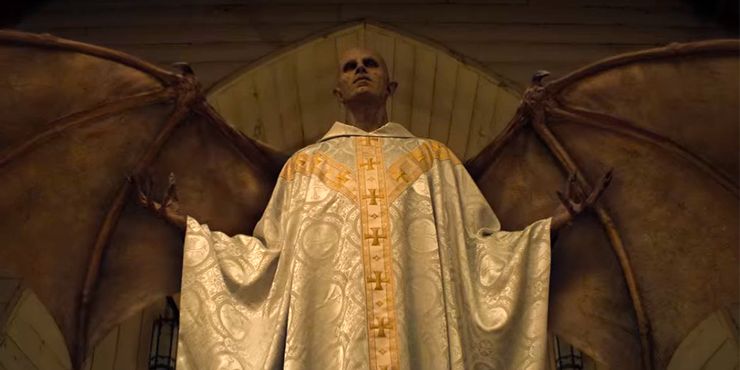
To those who are called let them be celibate! It is the life of angels, the real ones, who I promise you are a thousand times scarier (not to mention crueler and kinder) than what's presented in Midnight Mass. But I do not think those wishing to imitate the Holy Trinity and Christ and the Church, in marriage, are lesser. That wasn't really the point of clerical celibacy to begin with. Like what is so common in history a method of freeing people from totalitarianism become totalitarian themselves.
But there is a greater truth than this struggle, floating just above the vale of tears. Marriage and celibacy aren't equal. You can't compare them. They are different callings. As different as an apple and a shoe. Comparing them is almost laughable. Not quite, as there are similarities. But I can say the same between an apple and a shoe.
But the Latin Church couldn't see this truth. When you fight evil, when you destroy what you hate, you lose sight of what you love. And the mess in this show is the direct fault of a church that, until St. John Paul the Great, couldn't come up with a marriage theology beyond consent being a God-given grace. I will not say the East has been perfect. They haven't. The monastic fetish is nothing short of disturbing to me.
But the issues of Midnight Mass are systemic to the Catholic Church, especially the Latin Church. They simply aren't this severe in Orthodoxy.
Period.


